
Credit transfer to foreign university study lets you carry the semesters you already passed in Pakistan into a degree abroad, so you do not start from zero. For many students, a smooth credit transfer from Pakistan saves one or two years of fees. It all starts with a clean HEC attested transcript and the right university choice.
The problem is that nobody tells you the hidden rules. One wrong subject choice, an unverified transcript or too much credit can cost you your post-study work rights. Our team in Multan reviews this every week, and students from Lahore, Faisalabad and across Pakistan start their process with us online. Want to know how many of your credits could count? Get your Free Profile Assessment — it takes one message.
What Is Credit Transfer to Foreign University Study?
Credit transfer to foreign university study means a university abroad accepts the courses you passed in Pakistan as part of its own degree. Universities call it credit transfer, advanced standing, recognition of prior learning (RPL) or advanced entry. The result is the same: fewer subjects and a shorter, cheaper degree.
There are two common situations. Some students leave a Pakistani BS after one, two or three years and want to finish abroad. Others hold an ADP or diploma and want direct entry into the second or third year of a bachelor’s. A credit transfer from Pakistan works in both cases, but only when the subjects match closely.
Each country measures study differently, which is why every credit transfer to foreign university application is assessed by hand. Pakistani universities use semester credit hours, Europe uses ECTS (a full year is usually 60 ECTS), the UK uses its own credit points and Australia uses credit points per unit. Your credits are never copied one to one. The receiving university converts and compares them, course by course.
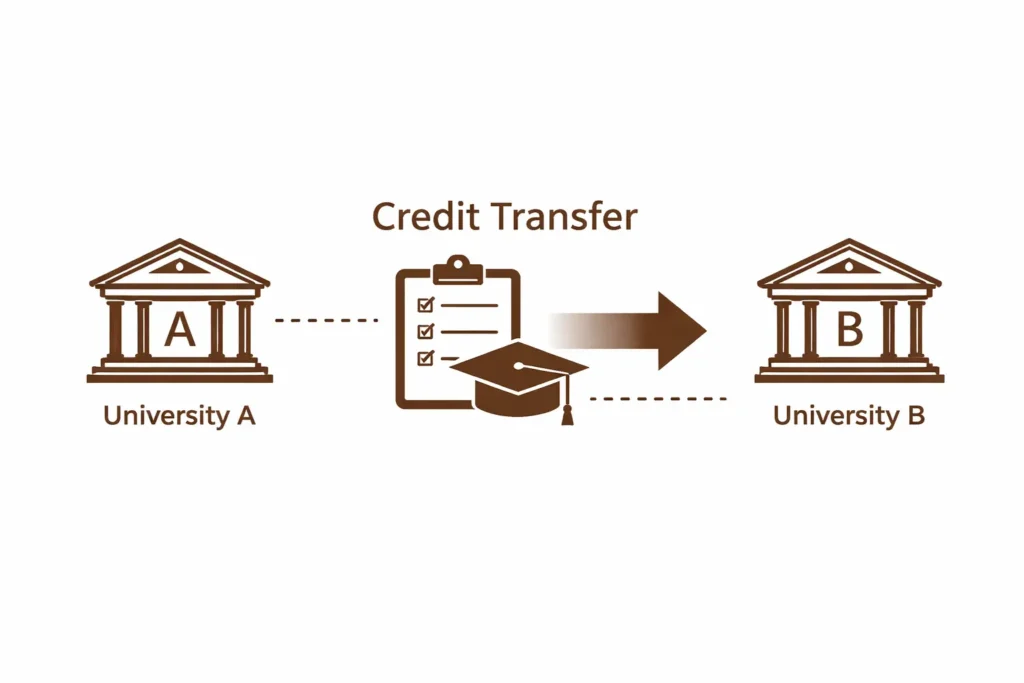
Credit Transfer from Pakistan: How Each Country Treats Your Credits
A credit transfer from Pakistan is possible in most popular study destinations, but every country handles it differently. Some decide credit at admission, others only after you enrol. Knowing which system you face decides how much you can save and how safe your visa file will be.
| Country | How credit transfer works |
|---|---|
| UK | Advanced entry to Year 2 or 3 is possible at some universities; your CAS shows the shortened course length |
| Australia | Advanced standing or RPL, decided by each faculty; credit shortens your course and visa |
| Canada | Transfer credit is usually assessed by the university after admission |
| USA | Transfer admission is common; colleges often ask for a course-by-course credential evaluation |
| Germany | Credits are converted to ECTS and recognised by the examination board |
| Malaysia | Private universities often accept transfer students into later semesters |
In the UK, universities that offer advanced entry issue your CAS for the real remaining course length, and your visa follows it. If you are planning to study in the UK from Pakistan, check this before you accept an offer. For Australian universities, the university must report any shorter course to immigration, so credit changes how long you can stay.
Canada and the USA are more flexible on transfer admission, but a credit transfer to foreign university offer there is rarely confirmed before you arrive. In Germany, a Pakistani FSc alone usually leads to a Studienkolleg year, while completed semesters in the same or a related subject at a recognised Pakistani university can open direct entry. Malaysia is popular for a quick credit transfer from Pakistan thanks to flexible intakes. You can compare all destinations on our study visa page.
Your HEC Attested Transcript: The Document That Decides Your Credit
Your HEC attested transcript is the base of every credit transfer to foreign university file. For any credit transfer from Pakistan, universities abroad want proof that your semesters are real, verified and from a recognised institution. Without proper attestation, strong grades can be rejected before anyone looks at your subjects.
The good news: HEC can attest a transcript for incomplete studies, even when your degree has not been issued, as long as the university clearly marks it as incomplete or degree in progress. Some European admission bodies now ask for an HEC attested transcript even for unfinished degrees and will verify it directly with HEC.
Here is where files break, even with an HEC attested transcript. A college-issued mark sheet, a transcript without the controller’s verification, a name that does not match your passport, or old attestation can each stop the process. Many universities also judge credit on course content, not just grades, so weak or missing course details can cut the credit you receive. We check your credit transfer to foreign university file in your Free Profile Assessment before you apply anywhere.
The Hidden Cost: When Credit Transfer Cuts Your Work Rights
Credit transfer to foreign university programmes can save fees, but taking too much credit can quietly cut your post-study work visa. Several countries link post-study work rights to how long you studied in that country. A shorter degree is cheaper today and can cost you a career route tomorrow.
Australia: the Temporary Graduate visa (subclass 485) needs at least two academic years of study in Australia — 92 weeks. Credit for overseas study does not count towards it, and Home Affairs treats credit as reducing your study time. Accept too much advanced standing in a credit transfer to foreign university degree and you may finish your degree without qualifying. Our Australia student visa requirements guide explains the wider visa picture.
Canada: the length of your post-graduation work permit is generally linked to your programme length. For many programmes, a course that becomes shorter than two years can mean a shorter permit. The full rules are in our Canada PGWP rules blog.
UK: your Student visa is issued for the shortened course on your CAS, so the timing of advanced entry and your graduation date matter for what comes next.
In any credit transfer to foreign university plan, the smartest move is not always maximum credit. It is the right amount of credit for your career goal. That calculation is part of your Free Profile Assessment.
4 Credit Transfer Mistakes That Cost Pakistani Students a Full Year
Most failed attempts at credit transfer to foreign university admission come from planning errors, not bad grades. Students apply to the wrong course, rely on the wrong papers or accept an offer without checking what the credit does to their visa. These four mistakes appear again and again.
1. Changing Subject and Expecting Full Credit
Credit only moves between closely matching subjects. Two years of BBA will not count much towards computer science, and the student who expects it often loses a year and money on the second plan. This is the most common reason a credit transfer to foreign university plan fails.
2. Applying Without a Properly Verified HEC Attested Transcript
A transcript issued by a college or department, missing verification, or with a spelling that differs from your passport can stop an application or a visa file. An HEC attested transcript must match your passport details exactly. The fix depends on your university and the country — get it checked before you pay any application fee.
3. Accepting the Maximum Credit Without Checking the Visa
Taking every credit offered can push you below a post-study work threshold or shorten your visa unexpectedly. This is the most expensive mistake on this list, because it often shows only after graduation.
4. Leaving a Pakistani Degree Without a Clear Visa Story
Visa officers ask why you left a degree halfway. A weak or inconsistent answer about your study gap, subject change or funding can lead to a refusal that stays on your record. A credit transfer from Pakistan needs a clear, logical academic story.
Not sure which of these applies to your credit transfer to foreign university plan? Book your free profile check or chat with us on WhatsApp and we will tell you where your file stands.
Best Time to Plan a Credit Transfer to Foreign University Admission
The best time to plan a credit transfer to foreign university admission is six to nine months before your intake, while you are still enrolled in Pakistan. Planning early lets you finish the right semester, collect verified results and target universities whose credit rules suit your subjects and work goals.
Leaving your Pakistani university first and planning later creates a study gap that you must explain. Timing also depends on the intake: some universities accept transfer students mainly in September, others also in January or February. Our fall vs spring intake guide shows how the two intakes compare. Request your HEC attested transcript early, because corrections take time, and plan your credit transfer to foreign university timeline around an intake you can realistically meet.
English Tests for Transfer Students and Low IELTS Score Options
Transfer students meet the same English rules as new students. Most universities accept IELTS Academic, PTE Academic and TOEFL iBT, and many UK universities also accept LanguageCert or Oxford ELLT. English-medium study in Pakistan is not always accepted, so check before your credit transfer to foreign university plan moves ahead.
Low IELTS Score? There Is Still a Route
If your score is below 6.0, Australia allows a packaged route: for its student visa, IELTS 5.5 works with at least 10 weeks of English (ELICOS) before your degree, and 5.0 with at least 20 weeks. UK and Canadian universities also run pre-sessional English courses, with entry scores set by each university. A short preparation course is often faster and cheaper than weeks of extra English abroad.
How LingoLab Helps You With Credit Transfer to Foreign University Plans
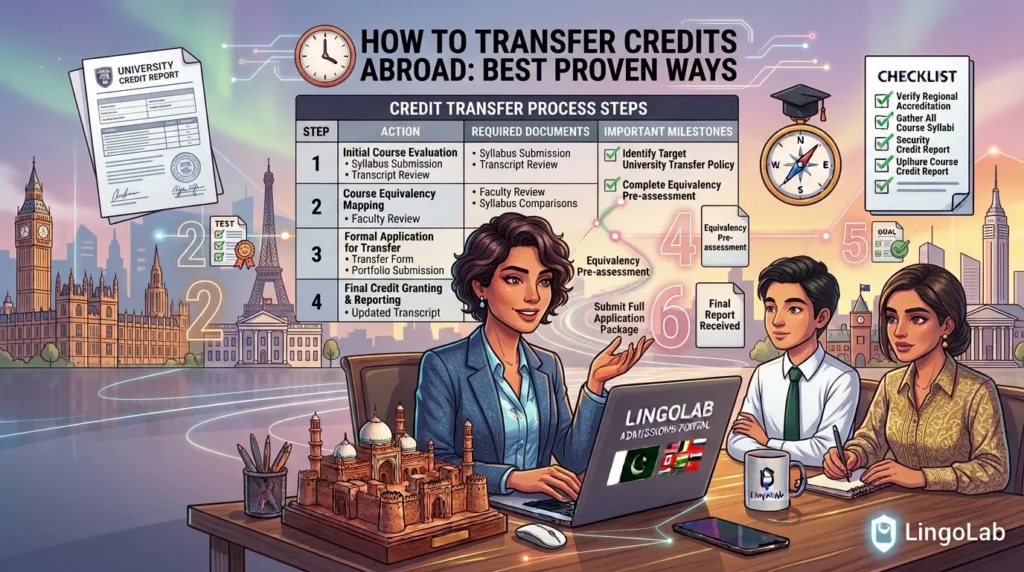
LingoLab turns your semesters in Pakistan into the strongest possible offer abroad. We handle credit transfer to foreign university admissions from start to finish, so you know your realistic credit, your exact costs and your visa risk before you spend money.
Students across Pakistan work with us online, based on results from students who succeeded with LingoLab & Career Counselling.
- Credit and eligibility review: we review your credit transfer from Pakistan and match your subjects with universities that recognise them and estimate realistic credit.
- University shortlisting and admission strategy across the UK, Australia, Canada, the USA, Europe and Malaysia, using top-ranked universities that fit your grades.
- Complete admission and visa file handling, including an HEC attested transcript check and a clear academic story for your study gap or subject change.
- Visa interview preparation and post-study work planning, with visa guidance for each country.
- Exact budget planning in PKR — try our cost calculator for a first estimate.
Prepare for your English test with LingoLab — online or on-campus in Multan: IELTS preparation · PTE classes · TOEFL preparation · Duolingo English Test preparation · LanguageCert preparation · Oxford ELLT preparation · Spoken English course
Frequently Asked Questions
Can I transfer my credits from a Pakistani university to a foreign university?
Yes, in many cases. A credit transfer to foreign university programmes works when your subjects closely match the new course and your university is recognised. Each university decides how much credit to give, so results differ even within one country. You will normally need an HEC attested transcript.
Which countries accept credit transfers from Pakistan?
The UK, Australia, Canada, the USA, Germany and Malaysia all accept credit transfer from Pakistan at many universities. The rules, timing and credit limits differ in each country, and some only confirm credit after you enrol.
Can I transfer to a UK university after 2 years of BS in Pakistan?
Some UK universities offer advanced entry into Year 2 or Year 3 for matching subjects. Many will offer Year 1 or Year 2 instead, depending on your subjects, grades and university. Your CAS and visa will show the shortened course length.
Will credit transfer affect my post-study work visa?
It can. In Australia, credit for overseas study does not count towards the 92-week study requirement for the Temporary Graduate visa. In Canada, a shorter programme can mean a shorter work permit. Check this before you accept any credit transfer to a foreign university offer.
Can I get credit transfer without IELTS?
Credit and English are separate checks. Most universities still ask for IELTS, PTE, TOEFL or another accepted test, and only some accept English-medium study in Pakistan as proof. A pre-sessional or packaged English course can sometimes cover a low score
Unsure About Your Profile or Test Scores?
Get your Free Profile Assessment from LingoLab experts today — find out how many of your credits could count abroad.
Written by Sana Gull — Senior Study Abroad Consultant & Founder at LingoLab.pk. British Council-certified agent processing Pakistani student visas. IDP, Pearson, LanguageCert Certified.