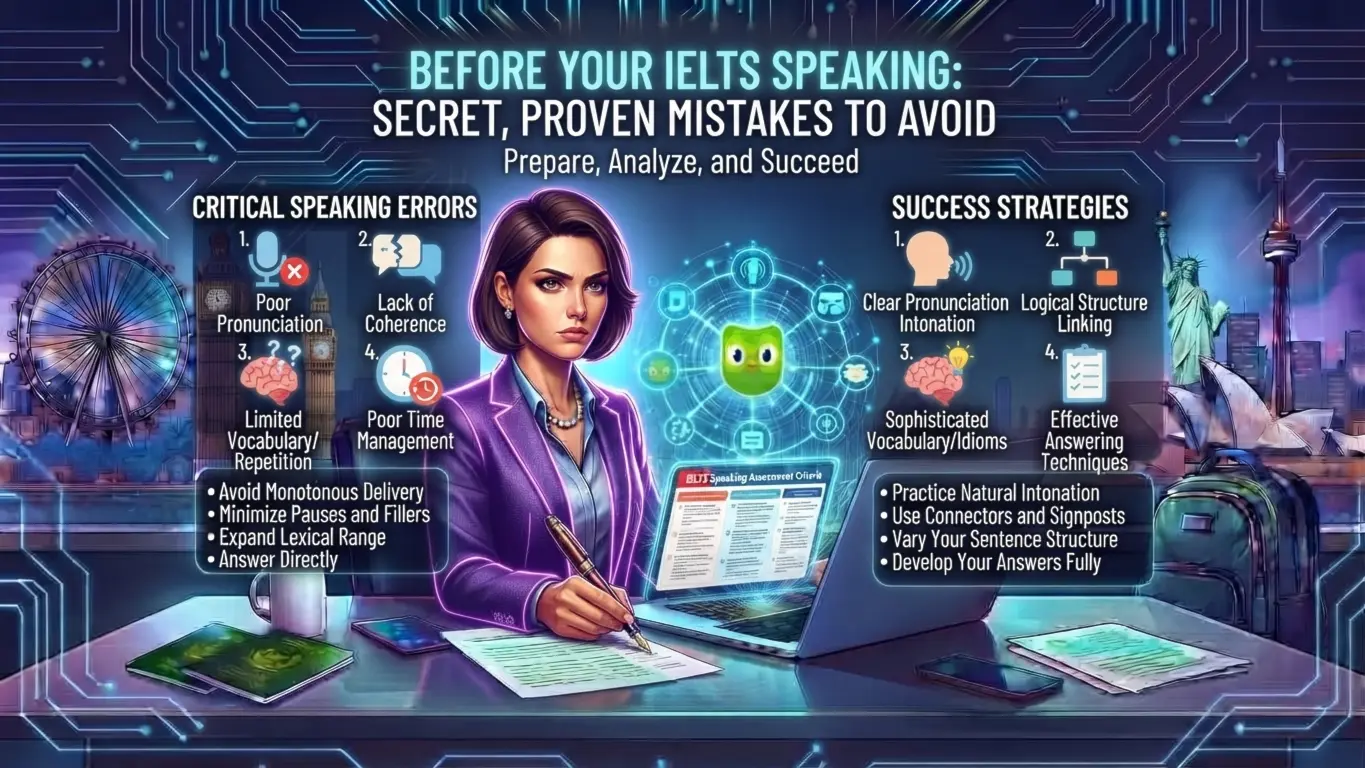
IELTS speaking tips that work for band 8 are very different from the “useful phrases” lists most students memorise. If you want an IELTS speaking band 8, the examiner must hear natural, flexible English, not a script. Our IELTS speaking practice online, with live teachers, helps students in Multan, across Pakistan and in the Gulf build exactly that.
Most IELTS speaking tips online miss one point. Speaking is the one IELTS skill where Pakistani students often know enough English but still lose a full band, usually through habits they cannot hear themselves. Students from Lahore, Faisalabad and across Pakistan start with us online. Want to know your real speaking band and the IELTS speaking tips that fit you? Get your Free Profile Assessment — it takes one message.
How the IELTS Speaking Test Works in 2026
The IELTS speaking test is an 11–14 minute live conversation with a trained examiner, in three parts. Even on computer-delivered IELTS, Speaking is never with a machine: it is face-to-face or by video call with a real examiner. Knowing the format is the first of all IELTS speaking tips.
| Part | What happens | Time |
|---|---|---|
| Part 1 | Short questions about you, your studies, work and daily life | 4–5 minutes |
| Part 2 | Speak alone on a topic card after 1 minute of planning | 3–4 minutes |
| Part 3 | Deeper discussion questions linked to Part 2 | 4–5 minutes |
These IELTS speaking tips apply to every version, because the IELTS speaking test is the same in IELTS Academic, IELTS General Training and IELTS for UKVI. Paper-based IELTS is being withdrawn in many countries during 2026, and computer delivery is now the standard, as the British Council explains on its IELTS on computer page. Speaking may be on the same day as your other parts or up to a week before or after.
IELTS Speaking Band Descriptors: What Band 8 Really Means
The IELTS speaking band descriptors mark you on four criteria, each worth 25%: Fluency and Coherence, Lexical Resource (vocabulary), Grammatical Range and Accuracy, and Pronunciation. An IELTS speaking band 8 needs strength in all four, not just good vocabulary or a confident manner in front of the examiner.
That is why single-trick IELTS speaking tips rarely work.
In simple words, here is what the IELTS speaking band descriptors expect at band 8:
| Criterion | What band 8 sounds like |
|---|---|
| Fluency and Coherence | Speaks at length with only rare hesitation; ideas link naturally |
| Lexical Resource | Wide vocabulary used flexibly, including less common words, used correctly |
| Grammatical Range and Accuracy | Wide range of structures; most sentences have no errors |
| Pronunciation | Easy to understand throughout; uses stress and intonation well |
Your final speaking band is the average of the four, so good IELTS speaking tips target your weakest criterion first. A student with excellent vocabulary but frequent grammar errors or flat pronunciation will usually land at 6.5 or 7, not an IELTS speaking band 8.
IELTS Speaking Tips That Actually Move Your Band
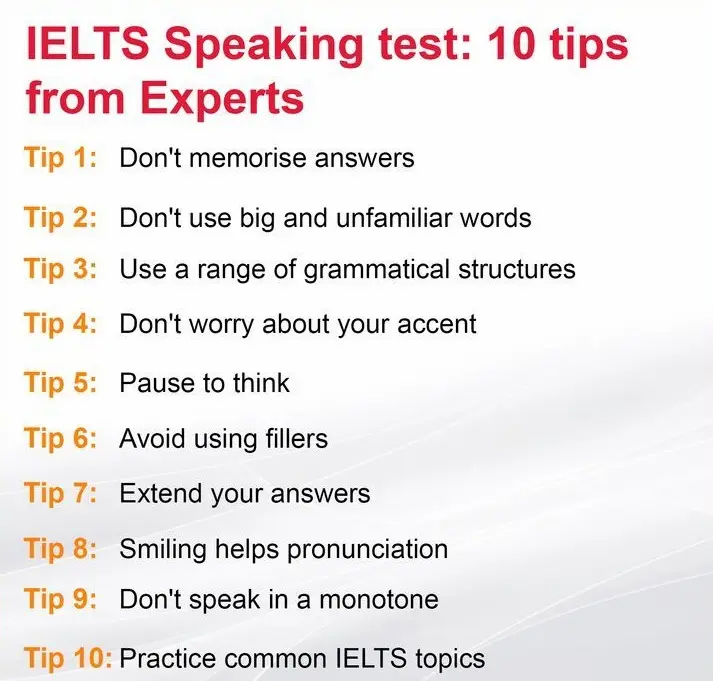
The IELTS speaking tips that work are about natural, extended answers, not tricks. Examiners are trained to spot memorised language, so the aim is real fluency: answering the question, adding a reason or example, and using a range of grammar and vocabulary without forcing it.
Part 1: Answer, Then Extend
The first of our IELTS speaking tips for Part 1: short answers sound unsure. Give a direct answer, then one reason or detail. Two or three sentences is usually enough.
Part 2: Use the Full Two Minutes
Among all IELTS speaking tips, this one matters most: the minute of planning decides your Part 2. Students who stop after 50 seconds lose fluency marks, and students who read memorised stories lose marks for vocabulary and coherence.
Part 3: Give Opinions With Reasons
Part 3 is where band 7 and IELTS speaking band 8 separate. The examiner wants opinions, comparisons and examples on wider topics, not personal stories.
Pronunciation: Clarity Over Accent
Your accent is not marked down. What matters is whether each word is clear and whether your stress and intonation help the listener. Of all IELTS speaking tips, this needs a listener most. Targeted IELTS speaking practice online with a teacher who can hear you is the fastest way to fix this.
These are general IELTS speaking tips. Which of them matters most for you depends on your current band, and that is what your free speaking check shows.
IELTS Speaking Tips: 7 Mistakes That Keep Students Below Band 7
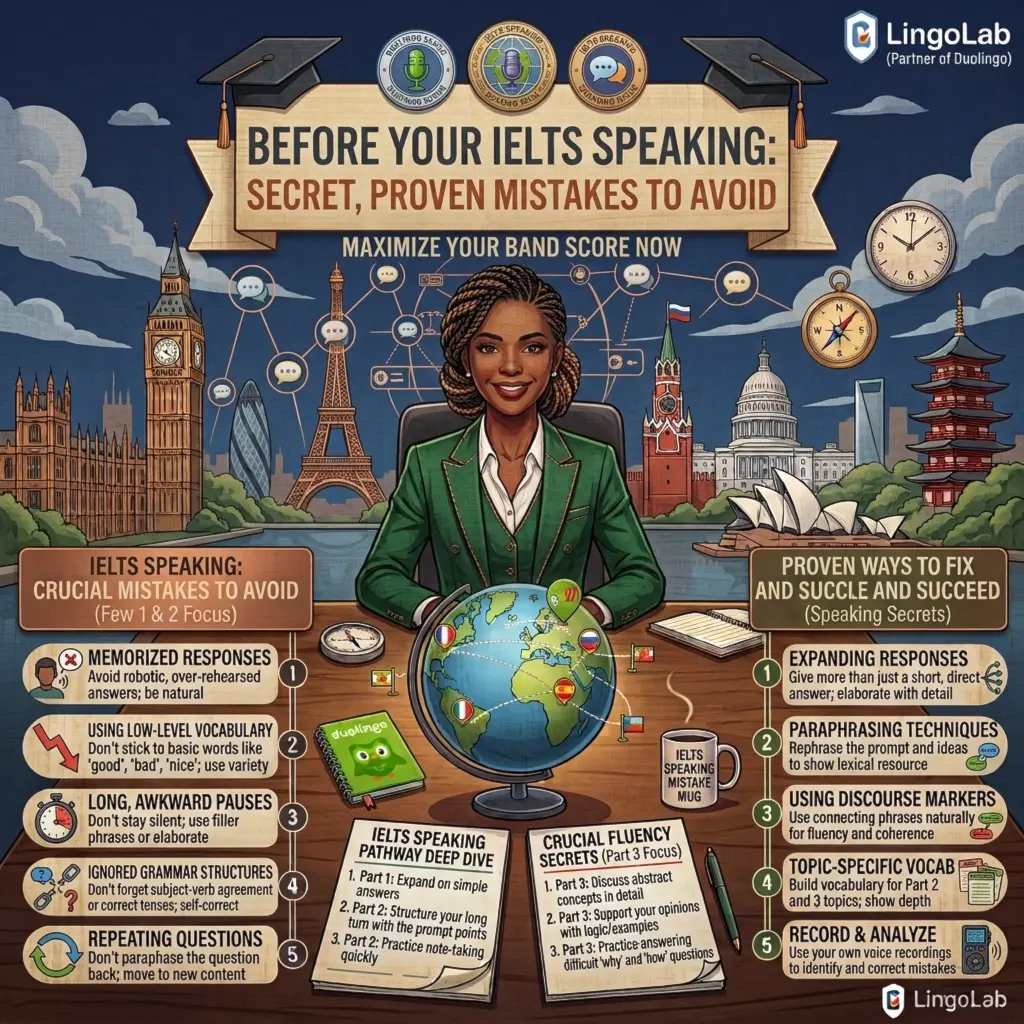
These seven mistakes come up in almost every mock IELTS speaking test we run, and most IELTS speaking tips online miss them. Each can hold a capable student at band 6. We name the problem here; the fix is planned in class and in your free assessment.
1. Memorised Answers
Many free IELTS speaking tips push ready-made answers, but examiners are trained to recognise rehearsed speech. Once they hear it, they change the question, and the band usually drops.
2. “Big Words” Used Wrongly
Rare words and idioms help only when used correctly. Forced vocabulary often lowers Lexical Resource instead of raising it.
3. Translating in Your Head
Thinking in Urdu, Punjabi or Saraiki and translating creates long pauses, which hurt Fluency and Coherence.
4. Answers That Are Too Short
One-line answers give the examiner too little language to mark at a high band.
5. Speaking Too Fast
Many nervous students rush. Speed does not equal fluency, and unclear words cost Pronunciation marks.
6. Only Simple Grammar
Every sentence in the present simple caps your Grammatical Range score, however correct it is.
7. Practising Alone
Students who only practise with recordings or friends never hear their own repeated errors. Reading IELTS speaking tips is not the same as being corrected. No feedback means no progress.
Recognise yourself in any of these? Book your free profile assessment or message us on WhatsApp and get your real speaking band.
Do You Need IELTS Speaking Band 8? What Your Plan Requires
The speaking band you need depends on your country, course and visa. Not everyone needs an IELTS speaking band 8. Many universities ask for 6.0–6.5 in Speaking, top universities ask for 7.0, and healthcare routes ask for more. Visa interviews in English test your speaking again, too.
- UK: degree-level study needs at least CEFR B2, and below-degree courses need B1 through IELTS for UKVI (4.0 in each skill). UK credibility interviews are also held in English. Explore options to study in the UK.
- Australia: for tests taken from 7 August 2025, the student visa minimum is IELTS 6.0 overall. Read our Australia student visa requirements blog and see how to study in Australia.
- Canada: universities set the score for admission, and the PGWP later needs CLB 7 (university) or CLB 5 (college) through an approved test. See our Canada PGWP rules blog and options to study in Canada.
- USA: the F-1 visa interview is a short spoken test in itself. Our USA student visa from Pakistan blog explains why.
- New Zealand: most courses ask for 6.0 or more. Read our New Zealand student visa from Pakistan blog.
Low IELTS Score? Official Routes That Still Work
In Australia, a 5.5 is accepted with at least 10 weeks of English (ELICOS), a foundation or an eligible pathway programme, and 5.0 with at least 20 weeks of ELICOS. In the UK, foundation and pathway courses need B1 (IELTS for UKVI 4.0 in each skill). Our IELTS guide gives a first look at band requirements; your best route is part of your free assessment.
IELTS Speaking vs Speaking in PTE, Duolingo and LanguageCert
Speaking is tested very differently across English tests. IELTS and LanguageCert use a live examiner, while PTE and TOEFL record you through a computer microphone and Duolingo mixes recorded and interactive tasks. Students who freeze with people sometimes do better with a computer, and the opposite is also true.
| Test | How Speaking is tested |
|---|---|
| IELTS (Academic, General Training, UKVI) | Live examiner, face-to-face or video call |
| LanguageCert Academic | Live examiner |
| PTE Academic / PTE Core | Recorded on computer, AI and human marking |
| TOEFL iBT | Recorded on computer |
| Duolingo English Test | Recorded and interactive tasks at home |
| Oxford ELLT | Live examiner by video |
If Speaking is your weakest skill, the right test can matter as much as the right IELTS speaking tips — and IELTS speaking practice online helps you compare formats safely. Your best test is checked in your free assessment.
IELTS Speaking Practice Online for Students in Pakistan and the Gulf
LingoLab runs IELTS speaking practice online and on-campus classes in Multan. Speaking needs a live listener, so our classes turn IELTS speaking tips into practice, built around video calls with a teacher who corrects you in real time, then full mock IELTS speaking tests scored against the official band descriptors.
Online IELTS Speaking Classes Across Pakistan
Students join our IELTS speaking practice online from Lahore, Karachi, Islamabad, Rawalpindi, Faisalabad, Bahawalpur, Sahiwal, Dera Ghazi Khan and smaller towns. You get the same teacher, the same mock tests and the same feedback as our Multan classroom, wherever you join IELTS speaking practice online.
Online IELTS Speaking Classes for Pakistanis in the Gulf
Pakistanis in Dubai, Abu Dhabi, Sharjah, Riyadh, Jeddah, Dammam, Doha and Muscat join our IELTS speaking practice online after work. Gulf time is 1–2 hours behind Pakistan, so evening batches fit easily. Students aiming for IELTS speaking band 8 use IELTS speaking practice online for IELTS Academic, while workers planning Canada or Australia migration usually need IELTS General Training, where the speaking test is the same.
What Good Online IELTS Speaking Classes Include
- A live teacher, not just recorded videos.
- Speaking practice on video call, with IELTS speaking tips applied to your own answers.
- Full mock speaking tests marked against the four criteria.
- Writing feedback too, because your overall band needs every skill.
- Flexible morning, evening and weekend timings.
Remember: online coaching and the official test are two different things. The official IELTS speaking test is taken with an examiner at a test centre or by video call arranged by the centre. The same online format is available for all other LingoLab tests — PTE, TOEFL, Duolingo, LanguageCert, Oxford ELLT, OET and Spoken English.
Want to join from anywhere in Pakistan or the Gulf? Message us on WhatsApp for online IELTS speaking classes.
How LingoLab Turns IELTS Speaking Tips Into Real Band Gains
LingoLab helps you reach IELTS speaking band 8, or the band your plan needs, through live practice, honest marking and a clear plan. Our IDP-certified team also runs study visa services, so we match your target band to your university, visa and interview.
Our IELTS speaking tips come from real marking experience. Students who tried free advice alone often join because friends who succeeded with LingoLab & Career Counselling recommended us.
- Free speaking check — your real band against the four criteria, and your target.
- IELTS preparation online and on-campus for IELTS Academic, General Training and IELTS for UKVI.
- Mock IELTS speaking tests with a predicted band toward IELTS speaking band 8, so you book only when you are ready.
- Visa interview preparation in English for UK, US and other interviews.
- Complete admission and visa file handling once your score is ready. Explore our study visa services.
Prepare for your English test with LingoLab — online or on-campus in Multan: IELTS preparation · PTE classes · TOEFL preparation · Duolingo English Test preparation · LanguageCert preparation · Oxford ELLT preparation · Spoken English course · All English courses
We have trained thousands of students to their target English scores and universities abroad — online across Pakistan and the Gulf.
Frequently Asked Questions
How can I get band 8 in IELTS speaking?
The honest answer to most IELTS speaking tips searches: an IELTS speaking band 8 needs strength in all four criteria: fluent, well-linked answers, flexible vocabulary, mostly error-free grammar and clear pronunciation. Natural IELTS speaking practice online or in class, with expert feedback, works far better than memorized answers.
Is the IELTS speaking test on a computer?
No. Even on computer-delivered IELTS, the speaking test is a live conversation with a trained examiner, face-to-face or by video call. Only Listening, Reading and Writing are on the computer.
How long is the IELTS speaking test?
The IELTS speaking test lasts 11–14 minutes in three parts: introduction questions, a two-minute talk on a topic card, and a deeper discussion.
Can I use memorized answers in IELTS speaking?
It is risky, and good IELTS speaking tips never recommend it. Examiners are trained to spot memorized speech and will change the question, and rehearsed answers usually score lower for fluency and vocabulary.
Does my accent affect my IELTS speaking score?
No, your accent itself is not penalised, even at IELTS speaking band 8. The examiner marks how clearly you speak, including individual sounds, word stress, and intonation. A clear Pakistani accent can score band 8.
What are the IELTS speaking band descriptors?
The IELTS speaking band descriptors are the official marking criteria: Fluency and Coherence, Lexical Resource, Grammatical Range and Accuracy, and Pronunciation, each worth 25% of your speaking band.
Is IELTS speaking coaching available online?
Yes. LingoLab runs IELTS speaking practice online with a live teacher, personal IELTS speaking tips, video-call speaking practice, mock speaking tests and marked writing, plus on-campus classes in Multan.
Can I join online IELTS speaking classes from Dubai, Saudi Arabia or Qatar?
Yes. Pakistanis in Dubai, Abu Dhabi, Sharjah, Riyadh, Jeddah, Dammam, Doha and Muscat join our online IELTS speaking classes, with evening and weekend batches that suit Gulf time.
Unsure About Your Profile or Test Scores?
Get your Free Profile Assessment from LingoLab experts today — get your real IELTS speaking band and a clear plan to your target.
Written by Team LingoLab — British Council-certified agent processing Pakistani student visas. IDP, Pearson, LanguageCert Certified.