
Fall vs spring intake is one of the first real decisions every student planning to study abroad has to make. Should you aim for the September intake 2027, or is the January intake 2027 a smarter, faster option? The answer depends on your country, your results, your English score and how ready your funds are — not on which date sounds closer.
This guide explains the fall vs spring intake choice for Pakistani students: how intakes work in each country, the pros and cons of each, what changed for 2027 and the timing mistakes that cost students a full year. Whether you are in Multan, or anywhere in Pakistan, you can start online — get your Free Profile Assessment to find the right intake for your profile.
Fall vs Spring Intake: What the Terms Really Mean
In the fall vs spring intake comparison, “fall” usually means classes starting in September or October, and “spring” means a start between January and April. But each country uses different names and dates, so the same word can mean different months depending on where you apply.
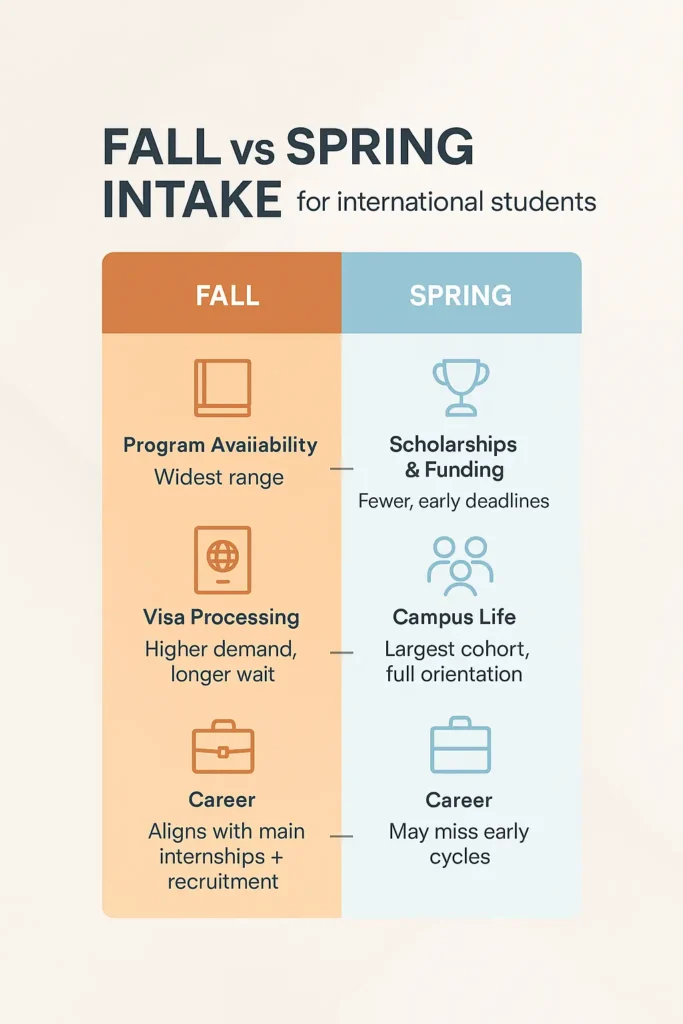
The fall intake is the main intake in the UK, USA, Canada, Ireland and most of Europe, with the most courses and scholarships. The spring intake is smaller: the UK, USA and Canada call it the January or winter intake, Germany calls it the summer semester starting in April, and some countries have no real spring intake at all. Australia and South Korea work differently again, with their main intakes in February and March.
Fall vs Spring Intake by Country
The fall vs spring intake picture changes by destination. Some countries offer two strong intakes, some have one main intake and a small second one, and a few effectively run on one intake only. The table shows the main and second intakes for the countries Pakistani students apply to most.
| Country | Main intake · Second intake |
|---|---|
| UK | September · January (fewer courses) |
| USA | Fall (August–September) · Spring (January) |
| Canada | September · January (some May) |
| Australia | February · July |
| Germany | Winter semester (October) · Summer semester (April) |
| Italy | September–October-–November · very few February starts |
| Ireland | September · some January |
| Nordic countries | Autumn (August–September) · limited spring options |
| South Korea, China | March and September |
Not sure which intake is realistic for your country and course? Get your Free Profile Assessment or chat with us on WhatsApp.
What Changed for 2027 Intakes
Several rule changes now affect timing. Since September 2025, UK universities must keep visa refusals below 5%, and some have paused or limited January recruitment from Pakistan. Australia has kept its planning level at 295,000 new students for 2027, and visas for a provider are processed more slowly once it reaches 80% of its allocation. Canada’s study permit cap runs by calendar year, although master’s and PhD students at public institutions no longer need a provincial attestation letter since 2026. Finland and Sweden still run one main application window for autumn.
September Intake 2027: Pros and Cons
In the fall vs spring intake decision, the September intake 2027 is the main fall intake in most countries and the default for Pakistani students. It offers the widest choice of courses and scholarships, but its deadlines come early, and competition for popular programmes and accommodation is highest.
Pros of the September intake 2027:
- The most courses, including programmes that only start once a year.
- The largest share of university scholarships and fee discounts.
- A full first year with your class, plus the main campus induction.
- More time after HSSC or bachelor’s results to prepare English tests and funds.
Cons of the September intake 2027:
- Earlier deadlines — many popular programmes close months before September.
- More competition for places, scholarships and housing.
- Summer visa rush, with slower processing in some countries.
January Intake 2027: Pros and Cons
On the spring side of the fall vs spring intake choice, the January intake 2027 is the main option in the UK, USA and Canada. It suits students who missed fall deadlines or need more time, but offers fewer courses and scholarships.
Pros of the January intake 2027:
- A second chance if you missed the fall deadlines.
- Extra months to improve your English score or arrange funds.
- Smaller classes and, at some universities, less competition.
Cons of the January intake 2027:
- Fewer courses — many programmes simply don’t start in January.
- Fewer scholarships and less accommodation choice.
- Some UK universities have paused or limited January intakes for Pakistani students.
- For many countries, January intake 2027 deadlines are closing now.

Fall vs Spring Intake: Which Should Pakistani Students Choose?
The right fall vs spring intake choice for Pakistani students depends on five things: when your results arrive, how ready your English score is, how ready your funds are, which country and course you want, and whether you need a scholarship. The calendar alone should not decide.
- Results timing: HSSC and bachelor’s results in Pakistan often arrive late in the year, which can make the September intake 2027 the realistic target rather than an earlier start.
- English score: if you still need IELTS or PTE, a later intake gives you time to reach the required band without rushing.
- Funds: most visas need funds held for a set period, so a later intake can protect your visa file.
- Course availability: if your course only starts in fall, the January intake 2027 is not an option.
- Scholarships: most university scholarships are tied to the fall intake.
When to Start Applying for Each Intake
For most countries, the best time to start is 9–12 months before your intake. For the September intake 2027, that means starting now; for the January intake 2027, most UK, US and Canadian deadlines fall in the autumn before, so many options are already closing.
For a fall vs spring intake plan, as a broad guide, Finland’s main application window runs in January and Sweden’s main deadline is 15 January for an autumn start, while many UK, Canadian and US fall deadlines run from winter into spring. Germany and Italy also set early pre-application dates. Starting late is the most common reason a fall vs spring intake plan fails.
Intake Mistakes That Cost Pakistani Students a Year
Most failed fall vs spring intake plans fail on timing, not on grades. These four mistakes regularly cost Pakistani students a full year, application fees and sometimes a visa refusal that stays on their record for future applications to the same or other countries.
1. Choosing January to “Save Time”
Many courses don’t start in January, which is the first thing to check in any fall vs spring intake comparison, and a rushed January file with weak funds or a borderline English score is more likely to be refused than a well-prepared September file.
2. Waiting for Results Before Shortlisting
Students who wait for every result before choosing a country often find deadlines already closed. Shortlisting and English preparation can start before results arrive.
3. Ignoring Caps and Processing Speed
In Australia, applying late in a provider’s allocation can slow your visa, and in Canada the yearly cap and provincial letters affect timing.
4. Arranging Funds Too Late
Most visas check how long money has been held, whatever your fall vs spring intake choice. Funds arranged at the last minute can weaken or sink an otherwise strong file.
Want to know which intake is safe for your profile? Get your Free Profile Assessment or WhatsApp us your profile.
How LingoLab Helps You Choose the Right Intake

LingoLab & Career Counselling helps you settle the fall vs spring intake question with a clear timeline built around your results, English score and funds — then handles your admission and visa files.
- Intake and country planning — the realistic September intake 2027 or January intake 2027 options for your profile.
- University shortlisting and admission strategy — courses that actually run in your chosen intake.
- Complete admission and visa file handling — through our study visa services.
- Exact budget planning in PKR — including when funds need to be in place for your visa.
- Visa interview preparation — so your file is ready when your intake’s visa window opens.
- English test preparation — timed so your score arrives before your deadlines.
Prepare for your English test with LingoLab — online from anywhere in Pakistan or on-campus: IELTS preparation · PTE classes · TOEFL preparation · Duolingo English Test preparation · LanguageCert preparation · Oxford ELLT preparation · Spoken English course
Read more in our guides to UK study visa requirements, Australia student visa requirements, Canada’s PGWP rules, studying in Germany and how to choose the best education consultant in Multan. For official 2027 planning figures, see Study Australia’s 2027 international education settings announcement.
Frequently Asked Questions
Which is better: fall vs spring intake?
For most Pakistani students, the fall intake is better because it offers the most courses and scholarships. The spring intake is a good second option if you missed fall deadlines or need more time for English or funds — but check that your course runs in spring first.
When should I apply for the September intake 2027?
Start 9–12 months before. For the September intake 2027, that means starting now — many Nordic, UK and US deadlines run from January to spring 2027, and Finland’s main window and Sweden’s 15 January deadline come first.
Is the January intake 2027 still possible?
In some countries, yes, but time is short. Many UK, US and Canadian deadlines for the January intake 2027 fall in autumn 2026, and some UK universities have limited January places for Pakistani applicants. Get your options checked quickly.
Do universities offer scholarships in the January intake?
Some do, but far fewer than in the fall intake. Most university scholarships and fee discounts are linked to September starts, so the fall intake is usually better if you need funding.
Does Germany have a spring intake?
Yes. Germany’s second intake is the summer semester, which starts in April, while the main winter semester starts in October. Many English-taught master’s programmes start only in the winter semester.
Which countries have February or March intakes?
Australia’s main intake is in February, and South Korea and China start in March as well as September. In these countries, the fall vs spring intake labels work differently from the UK or USA.
Does the intake affect my visa chances?
The intake itself doesn’t, but timing does. Rushed files with late funds or a borderline English score are refused more often, and in Australia late applications to busy providers can be processed more slowly.
Unsure About Your Profile or Test Scores?
Get your Free Profile Assessment from LingoLab experts today.
Written by Sana Gull — Senior Study Abroad Consultant & Founder at LingoLab.pk. British Council-certified agent processing Pakistani student visas. IDP, Pearson, LanguageCert Certified Trainer.